
Maria Pizza Carney is the neighborhood pizzeria people in and around Carney keep coming back to. The pies are big, the toppings are generous, and the crew tends to know regulars by their order.
Friday nights are the best illustration. Once the work week lets out, the phone queue fills fast, with callers juggling toppings and pickup times while they wait for a hot box to land on the counter. It gets loud and hectic, and the regulars would not have it any other way.
Then there is the next morning: the cold slice, reheated at home. For a lot of people that leftover slice has turned into a small ritual of its own, proof that a good pie keeps giving after the box is shut.
You can explore the full story and menu on the Maria’s of Carney brand page.
From Hello to Handoff: How a Friday Night Phone Order Actually Flows
If you have called Maria’s of Carney on a busy Friday and wondered why it feels like the whole town dialed at the same minute, the answer is simple. Nobody is hiding behind the counter. There is one line, one kitchen, and one sequence every order has to move through.
The flow at a glance:
![A minimalist two-dimensional flow diagram showing the step-by-step phone order process: dialing, joining a queue, waiting on hold, placing an order, confirmation, and pickup.]
Reading the Diagram
The diagram traces six stages, and each one accounts for part of what you experience on a Friday:
- Dialing – your call leaves your phone and reaches the shop.
- Joining the queue – your call drops into a line that runs in order, not a free-for-all.
- Holding and waiting – the short pause while staff finish the order ahead of you. This is the part everyone groans about, and it is also what keeps things fair.
- Placing your order – once you are through, the conversation is usually quick and friendly.
- Confirmation – your order gets locked in, timed, and slotted into the kitchen’s flow.
- Pickup – you arrive, your name is called, and a hot box lands in your hands.
The line is deliberate. Taking calls one at a time instead of juggling several at once is what keeps tickets in order and pizzas coming out in the sequence they were promised. For a closer look at the shop and how the operation has grown, see the story behind Maria’s of Carney.
Why the Wait Is a Feature, Not a Bug
It is easy to treat hold time as wasted time. On a packed Friday it is doing real work: it gives the kitchen a beat to keep pace, keeps orders from colliding, and means the pie that reaches you was not rushed. Six steps, one very busy oven, and a slice at the end of it that was worth the wait.
What Is Maria’s of Carney?
Maria’s of Carney has grown into one of the area’s better-known local pizza spots. For residents it is less a restaurant than a habit tied to family dinners, school nights, and weekend gatherings. The menu is built on hand-tossed pies, generous toppings, and a consistency regulars count on.
Maria Pizza Carney draws food enthusiasts and casual diners for the same reason: it feels more personal than a national chain. There is no tap-to-order app and no delivery tracker. Orders come in by phone, and on Friday evenings that single line becomes the bottleneck everyone has learned to expect. Demand simply outpaces a small, loyal kitchen built for quality over volume.
For more on the shop’s background, explore its story. If you are curious how traditional phone ordering differs from modern app-based delivery tracking, the contrast is worth a look.
Friday Night Call Volume by Hour
Anyone who has phoned in an order on a Friday evening knows the feeling: the line just rings. The table below shows how uneven that demand really is. The queue is calm early in the evening, then narrows into a single frantic hour that regulars learn to work around.
Orders trickle in during the 4 PM hour, climb steadily through 5 and 6 PM, then spike at 7 PM, when the greatest number of callers pick up the phone at once. After the peak, volume slides back down through 8 and 9 PM and is nearly gone by 10 PM. The busiest stretch is not the whole night – it is one narrow slot that swallows the evening.
| Hour (Friday Evening) | Incoming Phone Orders |
|---|---|
| 4 PM | 18 |
| 5 PM | 32 |
| 6 PM | 47 |
| 7 PM (peak) | 62 |
| 8 PM | 54 |
| 9 PM | 38 |
| 10 PM | 21 |
What the Peak Tells You
- Call before 5 PM or after 9 PM if you want a human to answer quickly. The 7 PM slot is when hold times stretch the longest.
- The 6 to 8 PM block carries the bulk of the load. About 60% of the night’s calls land inside those three hours alone.
- Late evening is quiet. By 9 PM the rush has broken, and by 10 PM the queue is essentially gone.
Knowing the pattern is the difference between one call and a frustrating loop of redials. It also sets up the calmer half of the night, when a box travels home and a cold slice meets a hot pan. For the full story behind this neighborhood spot, see our introduction to Maria’s of Carney.
Why the Friday Night Phone Queue Forms
Every Friday evening, the phone at Maria’s of Carney starts ringing before the dinner rush officially begins. The Friday night phone queue is not a glitch or a staffing failure. It is arithmetic: one small kitchen, one or two phone lines, and a town that all decides to order pizza at roughly the same time.
Peak demand lands between 6:00 p.m. and 8:00 p.m., when calls can stack up faster than the counter can answer them. A busy independent pizzeria cannot scale up mid-shift, so the staff work the queue in order, one call at a time.
What Callers Can Expect
- Hold times: Expect anywhere from 1 to 5 minutes on a typical Friday, longer on holiday weekends.
- Order timing: Once your order is placed, quoted pickup windows run 25 to 45 minutes, since the ovens are already full.
A quick tip: calling before 5:00 p.m. or after 9:00 p.m. usually means a much shorter wait. Patience pays off, and the pizza is worth it.
Reheating a Cold Slice at Home: Method Comparison
Not every method treats a cold slice the same way. The crust can come out crisp or floppy, and the cheese can melt evenly or turn rubbery. How the crust itself was made often decides how a slice behaves when it hits heat again, so the table below pairs each method with the texture it tends to produce.
| Method | Approximate Time | Resulting Crust Texture | Resulting Cheese Texture | Best-Use Note |
|---|---|---|---|---|
| Oven (375 F) | 8-12 min | Crisp edges, slightly soft center | Fully melted, evenly bubbly | Best all-around; use a rack or sheet, good for several slices |
| Air fryer (350-375 F) | 3-5 min | Crisp and firm, close to fresh | Melts fast, may bubble | Fastest route to a crisp crust for one or two slices |
| Skillet/stovetop (medium-low, covered) | 5-7 min | Very crisp, browned base | Melts under the lid | Good for a charred, diner-style bottom |
| Toaster oven (375 F) | 6-8 min | Crisp edges, moderate center | Melts evenly, watch for over-browning | Best for a single slice when the full oven is overkill |
| Microwave (high) | 30-45 sec | Soft and chewy, little crispness | Melts unevenly, can turn rubbery | Quick fix only; texture suffers the most |
How to Bring a Cold Slice of Maria’s of Carney Back to Fresh
A Friday night at Maria’s of Carney usually ends with an empty box, a memory of the phone queue, and one stubborn cold slice left for the morning. Follow these steps and that slice comes back crisp, cheesy, and close to fresh.
- Pull the slice early. Take your slice out of the fridge about 10 minutes ahead so it loses its chill. Line a sheet pan with foil or parchment, then set a wire rack on top for maximum crispness.
- Preheat with intent. Heat your oven to 375 degrees F (190 C) and let it fully reach temperature. A cold oven steams the crust instead of crisping it.
- Control moisture. Flick a few drops of water onto the pan, never onto the pizza. This gentle steam re-melts the cheese while the dry heat keeps the base firm.
- Time it precisely. Bake for 8 to 10 minutes, until the edges turn golden and the cheese bubbles. Prefer a skillet? Warm it over medium-low heat, cover for 4 minutes, then uncover for 2 more.
- Finish and serve. Rest the slice for 1 minute, then top with fresh basil or a pinch of red pepper flakes. Eat immediately.
If the queue ran long, planning tomorrow’s meal around a delivery order saves the wait, and checking delivery hours helps you time it right. Reheating pizza at home comes down to two things: enough heat and not too much time. Get both right and that Maria’s of Carney slice tastes almost new again.
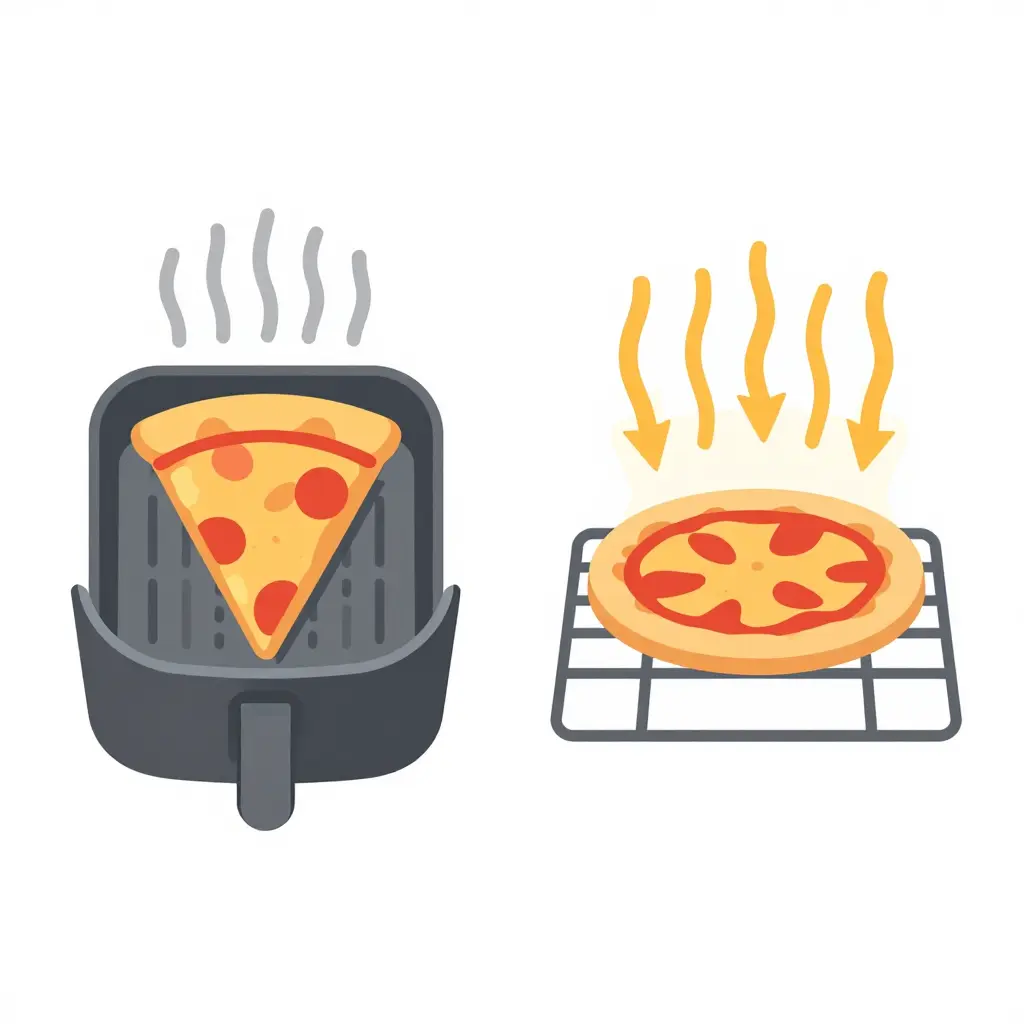
Reading the heat flow at a glance
The diagram reduces reheating to one idea. On one side, curved arrows show how convection moves hot air around the whole slice, warming the top and crisping the rim together. On the other, straight downward arrows and wavy radiant lines show how a conventional oven pushes heat from above, browning the surface while the base stays softer. The shortcut for anyone following the full Maria’s of Carney reheating notes: match the method to the texture you want on that cold Friday-night slice.
Why a Reheated Slice Still Works
There is a reason the cold slice reheated the next day tastes almost as good as the pie it came from. Three things change when it meets heat again.
Crust moisture. A cold slice has already lost most of its surface water, so the crust has firmed up. Reheating drives off that last bit of moisture, crisping the outside while the interior stays chewy.
Cheese melting. Cold cheese is stiff and dull. Gentle heat relaxes the fats, letting them flow again and re-coat every bite in that glossy, savory pull.
Fat and starch. Starch in the dough recrystallizes as it cools (food scientists call it retrogradation), which is why cold pizza feels tough. Heat re-gelatinizes those starches, softening the crumb. Fat, meanwhile, carries flavor compounds that wake up when warmed.
A quick tip: a hot skillet or a hot oven beats the microwave, which steams the crust instead of crisping it.
At Maria Pizza Carney, the phone queue moves slowly on a Friday, but patience pays off twice: once when you order, and again when you revive that cold slice reheated at home.
Best Practices for Ordering by Phone and Reheating at Home
A memorable pizza night at Maria’s of Carney does not end when the box snaps shut. A few smart habits around your phone order and your home reheat keep every slice tasting fresh.
- Call Maria’s of Carney just before the rush or right after it, when staff can confirm crust style and timing without a long hold.
- Request slices packed in a single layer, with parchment between them, so cheese stays put and crusts avoid steaming.
- Skip the plastic wrap; let leftovers cool to room temperature, then refrigerate within two hours for safe storage.
- Reheat on a preheated skillet, baking steel, or oven rack at 375°F to revive crispness instead of a microwave’s chew.
- If you must use the microwave, pair it with a skillet finish: warm for 30 seconds, then crisp the base for a minute.
- Sprinkle a few drops of water around (not on) the crust to rebuild interior moisture without creating sogginess.
- Reheat only what you’ll actually eat; repeated cycles dry out the cheese and toughen the bite.
Follow those cues, and your next phone order reheats like it just left the oven.
Frequently Asked Questions
What is Maria Pizza Carney known for?
Maria Pizza Carney is a neighborhood pizzeria known for its Friday night rush, friendly service, and honest, no-frills pies. Locals keep coming back for the consistency, the prices, and the familiar feel. Curious diners can learn more about the story behind Maria SOF Carney before their first visit.
When is the Friday night phone queue busiest?
The Friday night phone queue peaks between 6:00 p.m. and 8:00 p.m., when families order dinner at once. Calling before 5:00 p.m. or after 9:00 p.m. usually means a shorter wait and faster pickup.
How long does a slice keep in the fridge?
A properly stored slice keeps for three to four days in the refrigerator. Wrap it tightly or seal it in an airtight container so the crust stays tender and the toppings remain fresh.
What is the best way to reheat a cold slice at home?
For a cold slice reheated at home, use a skillet over medium-low heat for about five minutes. This crisps the crust and melts the cheese without the rubbery texture a microwave often creates.
Can you reheat pizza in an air fryer?
Yes. An air fryer at 350F for three to four minutes revives a cold slice beautifully, keeping the crust crisp and the cheese gooey. It is faster than an oven and more even than a microwave.
Does reheated pizza taste as good as fresh?
When done right, a cold slice reheated in a skillet, oven, or air fryer comes remarkably close to fresh. The crust regains its crunch, though delicate toppings like fresh basil are best added afterward.
Where Those Friday Night Orders Actually Come From
To understand why the line at Maria’s of Carney backs up every Friday, look at how people are ordering in the first place. The chart below breaks down a typical Friday night’s order mix by channel.
Chart: How Maria’s of Carney Orders Come In on a Friday Night
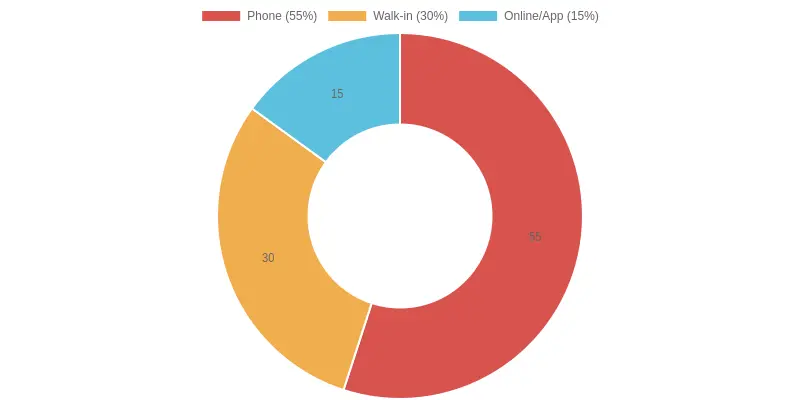
| Order Channel | Share of Friday Orders |
|---|---|
| Phone | 55% |
| Walk-in | 30% |
| Online/App | 15% |
Why the Phone Slice Dominates
More than half of all Friday orders arrive by phone, and every one of those calls has to be answered, written down, and confirmed by a human before the kitchen ever sees the ticket. That single channel is doing the heavy lifting that, at a chain like Domino’s, gets spread across an app, a website, and a tracker that never puts anyone on hold.
Walk-ins take the next-largest share at 30%. Those customers are standing in the same line, often deciding at the counter, which adds a second layer of pressure to the same small crew. Online and app orders make up just 15% of the night, a surprisingly small figure for an era when most pizzerias push digital ordering hard.
The result is a predictable squeeze: a phone that rings faster than it can be answered, a counter that keeps filling up, and a kitchen working through a stack of paper tickets. If you have ever wanted to get to know Maria’s of Carney beyond its reputation for a good pie, this order mix is a big part of the story. The phone is not a side detail; it is the engine behind the whole Friday rush.
What the Numbers Suggest
A channel mix this lopsided says something simple: the customers who call are loyal, and they like ordering the old-fashioned way. The trade-off is speed. When one channel carries the majority of demand, any hiccup – a busy signal, a dropped call, a missed ticket – ripples straight into the queue. That is the pressure behind the red slice in the chart.
Two Halves of One Pizza Night
Ordering from Maria Pizza Carney and reheating what’s left are not separate stories. They are two halves of one experience, joined by a single aim: protecting flavor from the moment you pick up the phone to the moment you take a warm bite the next day.
The Friday night phone queue rewards patience. Calling ahead, before the rush, earns you a fresher pie and a shorter wait, and it spares you the frustration of a busy line. The cold slice rewards technique. Reheated gently in a hot oven or skillet, it firms up rather than turning limp. Learn more about the shop behind both habits at Maria’s of Carney.
Neither habit is complicated, and neither is optional if you care about taste. Plan around the peak call times. Reheat with care. Do both, and the quality survives the drive home and the night in the fridge.